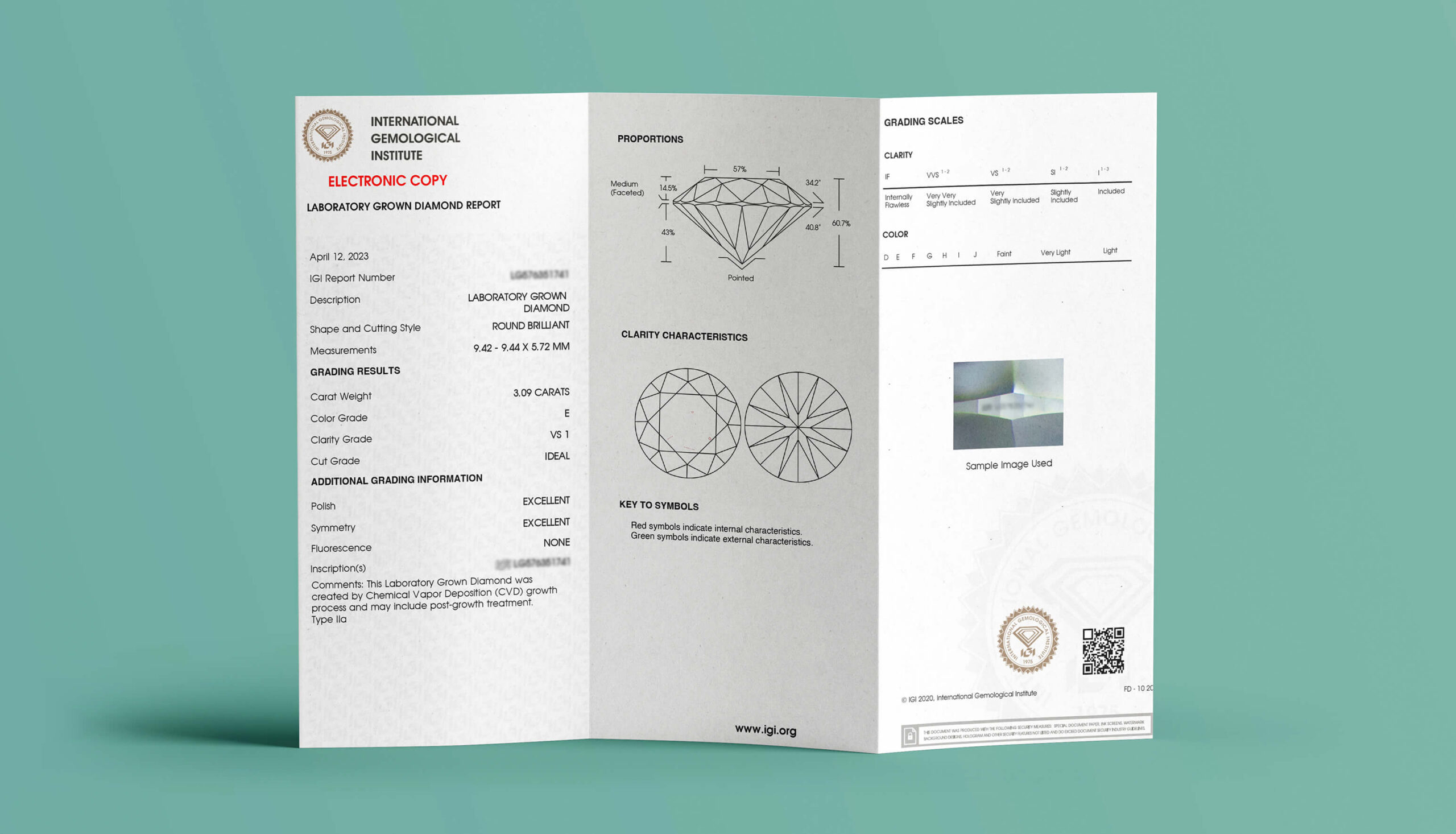

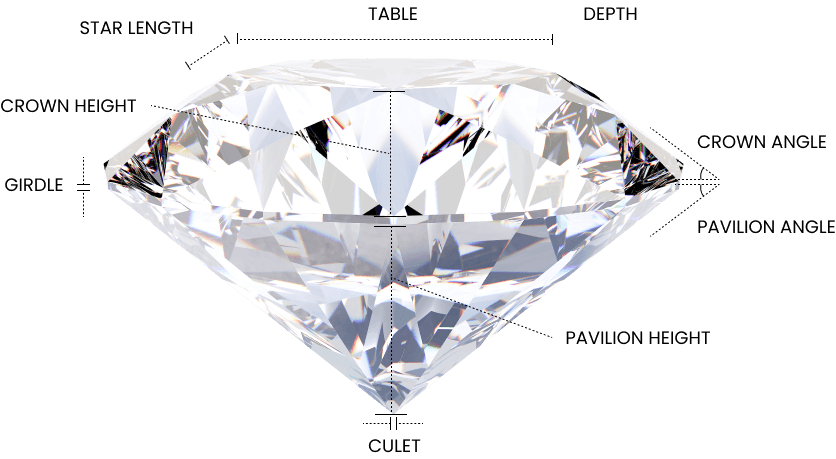
The table facet is typically a large, square or rectangular shaped facet that is located on the crown of the diamond. The size of the table is an important factor in determining the diamond's brilliance. It influences how much light enters the diamond and how much is reflected back.

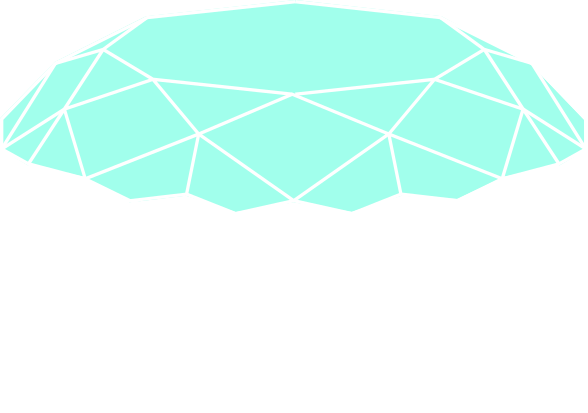
The crown is the upper portion of the diamond, from the top edge of the girdle to the table. The average crown height is expressed as a percentage of the average girdle diameter. It can affect both the dispersion and brightness of a diamond.

The crown angle is the angle that’s formed where the bezel facets meet the girdle plane. The best range of crown angles provides a route for exiting light dispersion, as well as additional contrasting directions for entering light.

This is another important dimension of the stone since it enhances a diamond’s brightness. It is the average of the angles formed by the diamond’s pavilion main facets and its girdle plane.
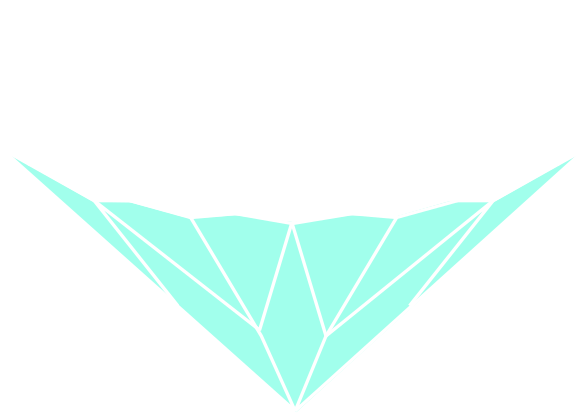
The pavilion is the “bottom half” of the diamond and is usually hidden under a ring setting. As the pavilion contains facets that bounce, enter, and reflect light, it plays an important role in the overall look of a diamond.

The girdle is the middle portion of a diamond – it’s a narrow section separating the crown from the pavilion, and functions as the diamond’s setting edge. The girdle thickness is described as a range from its thinnest to thickest areas. A girdle that is “medium to slightly thick” is preferred. Cause a thick girdle is less

The culet is the small facet at the bottom of a diamond intended to prevent chipping and abrasion to the point. The culet size can affect face-up appearance and it’s described as the average width of the facet.

The diamond’s overall depth from the surface of the table to the culet, expressed as a percentage of the average girdle diameter.

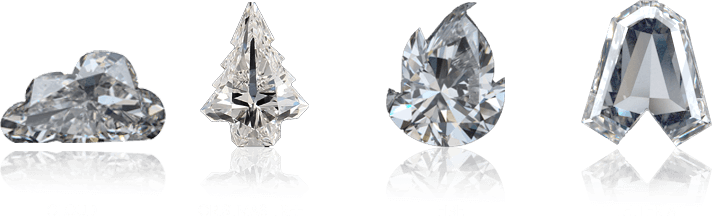
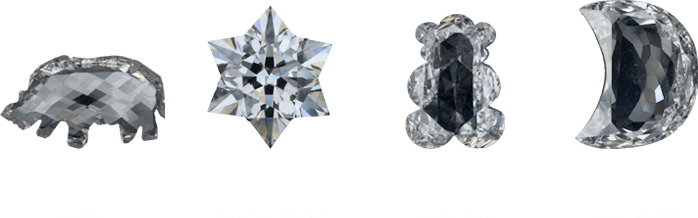
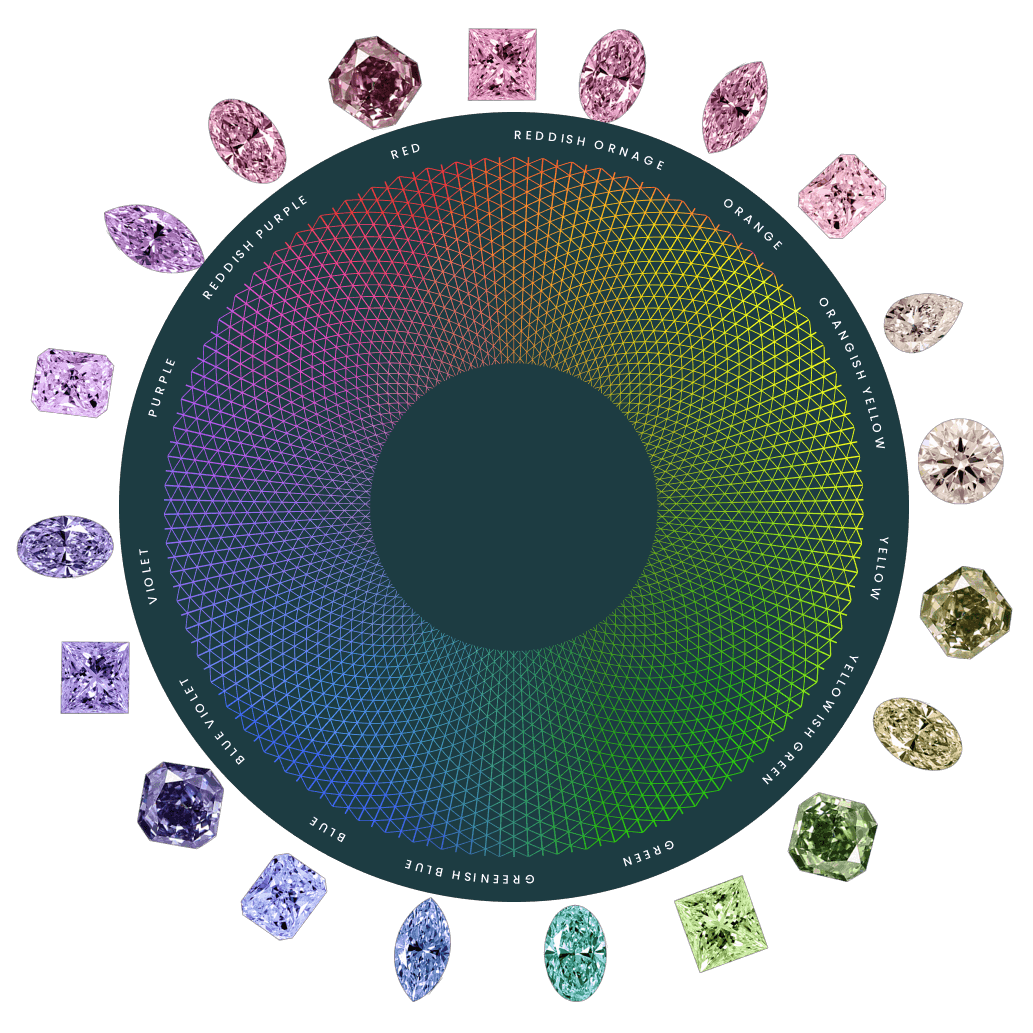
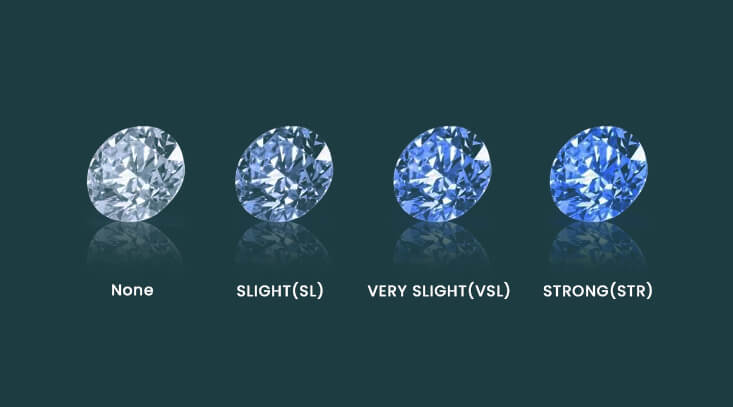


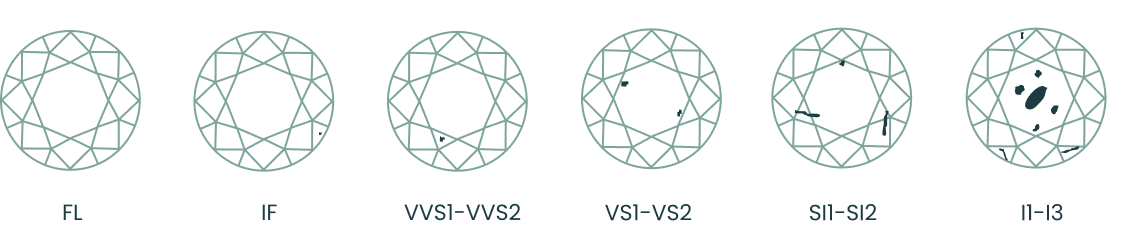
| FL | Flawless (FL) No internal & external inclusions and no blemishes visible under 10x magnification |
| IF | Internally Flawless (IF) No inclusions visible under 10x magnification |
| VVS1-VVS2 | Very, Very Slightly Included (VVS1 and VVS2) Inclusions so slight they are difficult for a skilled grader to see under 10x magnification |
| VS1-VS2 | Very Slightly Included (VS1 and VS2) Inclusions are observed with effort under 10x magnification, but can be characterized as minor |
| SI1-SI2 | Slightly Included (SI1 and SI2) Inclusions are noticeable under 10x magnification |
| I1-I3 | Included (I1, I2, and I3) Inclusions are obvious under 10x magnification which may affect transparency and brilliance |
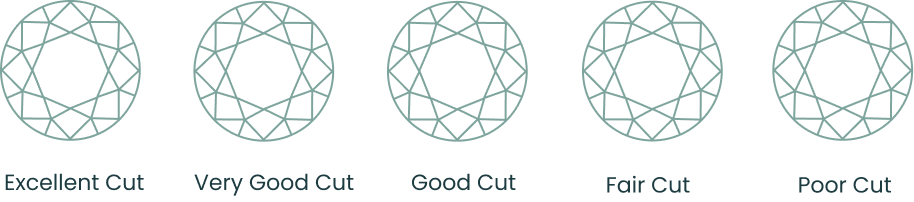
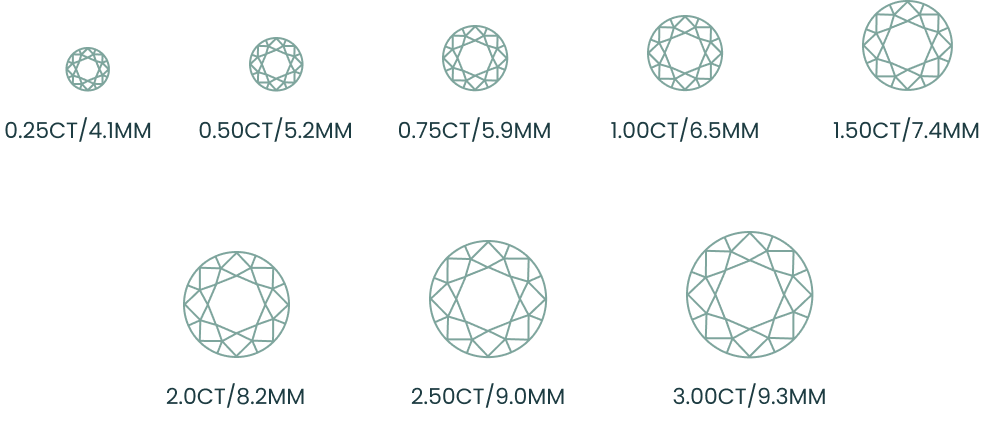
The weight or size of a diamond is measured in carats (ct.).One carat weighs 1/5 of a gram and is divided into 100 points, so a diamond weighing 1.07 ct. is referred to as “one carat and seven points.”For example,
With an accuracy of 1/100,000 carat, the IGI scales provide a highly precise diamond weight, down to the hundredth or thousandth of a carat.It is important to note that diamonds of the same weight don’t necessarily have the same size appearance. Those cut too shallow or deep may look small for their weight, or suffer in brilliance. As a reference, IGI recommends the following vertical spreads for round brilliant diamonds.
When diamonds are mined, large gems are discovered much less frequently than small ones, which make large diamonds much more valuable.Diamond prices rise exponentially with carat weight. So, a 2-carat diamond of a given quality is always worth more than two 1-carat diamonds of the same quality.